

Contents
Preparations After Getting into the Car
- Adjust the seat Whether the seat is adjusted properly directly affects your control of the brake pedal.
- Adjust the rear-view mirrors Proper mirror adjustment directly affects all reference points that need to be observed through the mirrors.
- Turn the knob to
Lto adjust the left rear-view mirror. Adjust it so that the vehicle body occupies about of the mirror. - First adjust the mirror upward until you can see the left rear door handle, then adjust it downward so that the left rear door handle touches the upper edge of the mirror.
- Make sure that the left rear wheel is visible.
Similarly, adjust the right rear-view mirror:
- Turn the knob to
Rto adjust the right rear-view mirror. Adjust it so that the vehicle body occupies about of the mirror. - First adjust the mirror upward until you can see the right rear door handle, then adjust it downward so that the right rear door handle touches the upper edge of the mirror.
If the mirror cannot be adjusted to the desired position, you can compensate by adjusting the seat position and your sitting posture.
- Before the vehicle starts moving, do not rush to press the brake and shift into Drive. Be sure to check whether the parking brake has been fully released, whether the seat belt is fastened, and whether the doors are completely closed. These are all indicated on the instrument panel.
- Slowly release the brake. Once you have confirmed that all preparations are complete, shift into gear and slowly release the brake pedal.
Common points where marks may be deducted before entering an exam item:
- Parking brake not fully released
- Seat belt not fastened as required
- Door not completely closed
I. Reverse Parking into a Garage
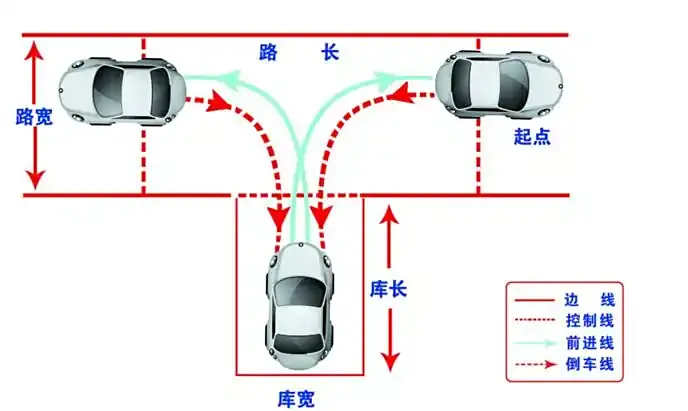
Exam operation requirements: Starting from the control line at one end of the road, with the contact points of both front wheels outside the control line, reverse into the garage and stop. Then drive forward out of the garage toward the control line at the other end. After the contact points of both front wheels have passed the control line, reverse into the garage and stop again. Then drive forward out of the garage and return to the starting point. During the exam, the vehicle must not stop while moving forward or backward. The entire item must be completed within 210 seconds.
-
When entering the item, make sure the steering wheel is aligned correctly with the guide line (the center between the 2nd and 3rd dashed lines). Make small steering corrections while moving and try to enter the item with the vehicle straight. If the front of the vehicle is too far left, the shoulder reference point will arrive too early. If the front is too far right, the shoulder reference point will arrive too late. If the vehicle body is too far left, it is easy to cross the left boundary line while reversing into the garage. If the vehicle body is too far right, the entry angle may be insufficient, making it difficult to adjust and possibly causing the vehicle to hit the garage corner or boundary line.
-
After entering the garage, if the vehicle body is not straight, adjust it immediately.
-
After completing the right-side reverse parking and driving out of the garage, wait until the left rear wheel has passed the garage corner before turning the steering wheel. Turning too early may result in an insufficient angle when performing the left-side reverse parking, making adjustment difficult or causing the vehicle to hit the garage corner or boundary line. Turning too late may cause the vehicle to cross the right boundary line while reversing.
-
When driving out after the left-side reverse parking, you do not need to wait until the rear wheel has completely left the garage. You may begin turning when the rear wheel is about to reach the garage corner. The exact timing depends on the distance between the vehicle body and the boundary line.
Exam evaluation standards:
| 1. Failing to follow the prescribed route or sequence | Fail |
| 2. Vehicle body crosses the boundary line | Fail |
| 3. Failing to reverse fully into the garage | Fail |
| 4. Failing to drive both front-wheel contact points past the control line | Fail |
| 5. Completion time exceeds 210 seconds | Fail |
| 6. Stopping for more than 2 seconds during the maneuver | Deduct 5 points each time |
II. Parallel Parking
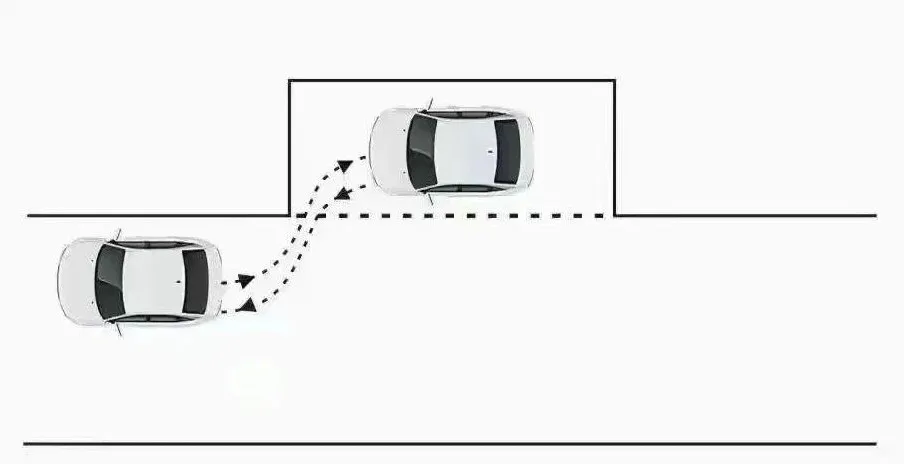
Exam operation requirements: Reverse into the parking space in one continuous maneuver from in front of the space, without stopping midway. The wheels must not touch or cross the lane boundary line, and the vehicle body must not touch the parking-space boundary line. Then drive forward and exit toward the front left. Before exiting, turn on the left turn signal. During the exit, the wheels must not touch or cross the lane boundary line, and the vehicle body must not touch the parking-space boundary line. Turn off the turn signal after leaving the space. The entire item must be completed within 90 seconds.
-
When entering the item, align with the guide line (aim at the red warning bollard ahead). Make small steering corrections while moving and try to enter with the vehicle straight. If the vehicle body is too far left, it is easy to cross the left boundary line while reversing into the space. Keep the right side of the vehicle approximately 30–50 cm from the boundary line.
-
After stopping, check in the mirror whether the vehicle body is parallel to the boundary line. If the front of the vehicle points to the left, the garage corner will disappear too early when reversing in. In this case, as soon as the garage corner disappears, turn the steering wheel fully. If the front points to the right, turn slightly to the right while reversing to straighten the vehicle a little, preventing the vehicle body from being too far left when turning and crossing the left line.
-
When observing the rear corner of the parking space during entry, if the corner has already passed when you see it, meaning the steering wheel was straightened too late, then on the final full-left turn, do not wait until the rear wheel touches the line. Turn fully just before it reaches the line to pull the vehicle slightly left and prevent crossing the right boundary line after entering the space.
-
When exiting, turn on the signal first and then shift gear. Wait until the reference point reaches the line before turning the steering wheel. Straighten the steering wheel promptly once the vehicle body is straight to avoid crossing the right boundary line.
Note: Volkswagen turn-signal levers have two detent positions. You need to push the lever firmly enough for it to engage fully.
Exam evaluation standards:
| 1. Failing to follow the prescribed route or sequence | Fail |
| 2. Vehicle body extends outside the parking space after stopping | Fail |
| 3. Completion time exceeds 90 seconds | Fail |
| 4. Failing to use the turn signal or using it incorrectly when exiting | Deduct 10 points |
| 5. Vehicle body touches the parking-space boundary line while moving | Deduct 10 points each time |
| 6. Wheels touch or cross the parking-space boundary line while moving | Deduct 10 points each time |
| 7. Wheels touch or cross the lane-edge line while moving | Deduct 10 points each time |
| 8. Stopping for more than 2 seconds during the maneuver | Deduct 5 points each time |
III. Curve Driving
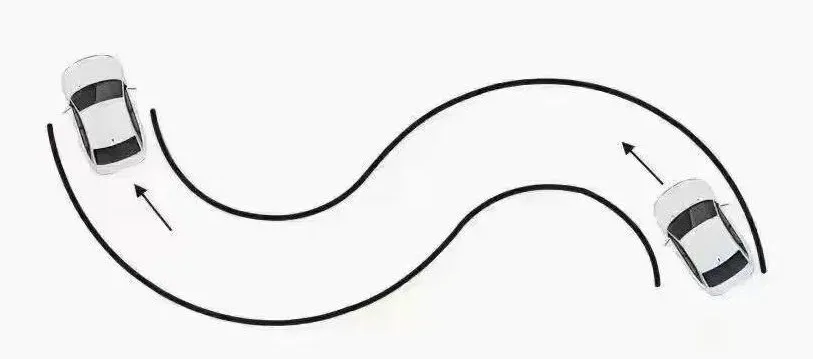
Exam operation requirements: Drive forward into the curved road from one end and exit from the other end. Steering and speed should remain smooth and steady. Do not stop midway, and the wheels must not touch or cross the lane boundary lines.
-
Entering the curve: Sit upright so that you can see the farthest visible points on both the left and right edges of the hood. Before entering the curve, adjust the vehicle so that the front is centered between the two boundary lines. If you enter the curve correctly, the rest of the maneuver will feel much smoother.
-
Left curve: At the reference point, turn the steering wheel one full turn to the left, then use the correction method to keep the reference point close to the right boundary line. Volkswagen vehicles do not require the additional adjustment.
-
At the transition point between the two curves, straighten the steering wheel.
-
Right curve: At the reference point, turn the steering wheel one full turn to the right, then use the correction method to keep the reference point close to the left boundary line.
Exam evaluation standards:
| 1. Failing to follow the prescribed route or sequence | Fail |
| 2. Wheels cross the road-edge line | Fail |
| 3. Stopping for more than 2 seconds during the maneuver | Deduct 5 points each time |
IV. Right-Angle Turn
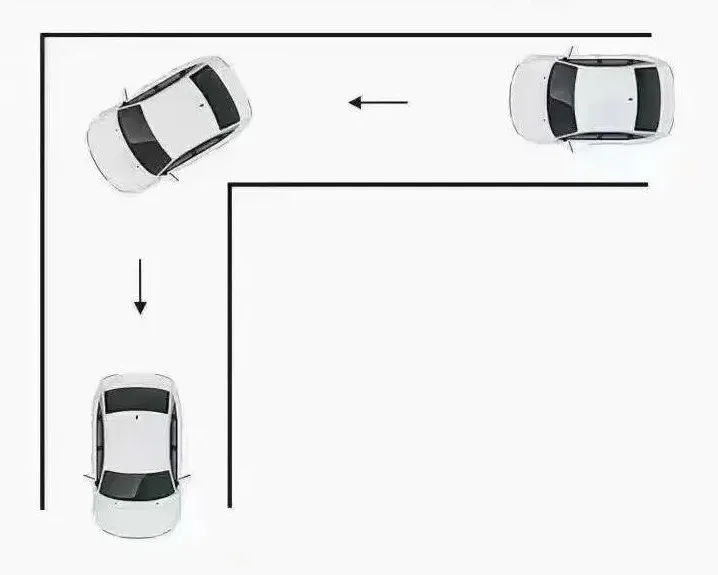
Exam operation requirements: Drive along the prescribed route and make a right-angle turn from left to right in one continuous maneuver. Do not stop midway, and the wheels must not touch or cross the lane boundary lines. Before turning, turn on the turn signal. After completing the turn, turn off the turn signal.
-
When entering the item, align correctly with the guide line. Make small steering corrections while moving and try to enter with the vehicle straight. If the front of the vehicle is too far left, the reference point will arrive too early. If the front is too far right, the reference point will arrive too late.
-
When passing the garage corner, pay close attention to the distance between the left rear wheel and the corner. The standard distance is 20 cm. If the deviation is small, no adjustment is needed. If the wheel is very close to the corner or even crosses it, the turning point was too early, so next time delay the steering input by about 2–3 seconds. If the distance is too large or the vehicle crosses the right boundary line, the turning point was too late, so next time turn about 2–3 seconds earlier.
Exam evaluation standards:
| 1. Failing to follow the prescribed route or sequence | Fail |
| 2. Wheels cross the road-edge line | Fail |
| 3. Failing to use the turn signal or using it incorrectly before the turn | Deduct 10 points each time |
| 4. Failing to turn off the turn signal after the turn | Deduct 10 points each time |
| 5. Stopping for more than 2 seconds during the maneuver | Deduct 5 points each time |