§7 Elliptic Curves
Definition 7.1 Let f(x) be a well-behaved cubic polynomial. The elliptic curve defined by f is the set
E:={O}∪{(x,y)∣y2=f(x)}.
Example 7.1 The solutions of the equation are shown below:
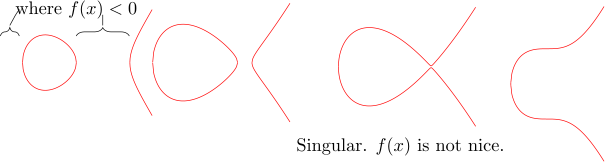
Notice that
(x,y)∈E⇒(x,−y)∈E.
Theorem 7.1 Every elliptic curve is an Abelian group.
This is surprising. We define the group operation as follows:
E×E(P,Q)→E↦P+Q
(1) If P,Q=O, define
O+O=O.
(2) If
P=O and
Q=(x,y)∈E,
define
O+Q=Q+O=Q.
(3) If P,Q belong to
{(x,y)∣y2=f(x)},
consider the unique line LPQ containing both of them.
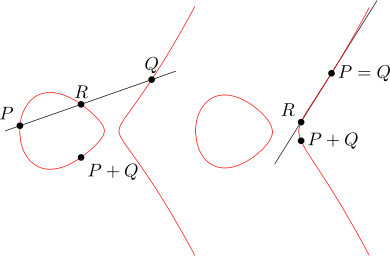
A line L intersects a cubic curve at three points. Let
R=(x,y)
be the third point of intersection. We define
P+Q:=(x,−y).
Rule: If LPQ is a vertical line, then it has no third point of intersection in R2. We define the third intersection point R to be the “point at infinity”
O.
(This is really an interpretation coming from projective geometry, where parallel lines—for example, vertical lines—intersect at a point at infinity.)
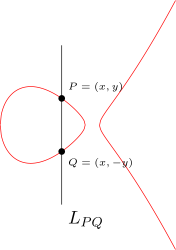
Notice that
LPQ=LQP,
so
Proving that
E×E→E
is associative is more difficult.
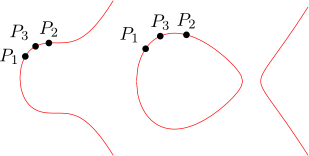
I suggest choosing three adjacent points.
Proposition 7.2
(P1+P2)+P3=P1+(P2+P3).
Here is a wonderful observation. Suppose
f(x)=a3x3+a2x2+a1x+a0
with
ai∈Q.
If
P,Q∈E
are rational points, meaning that both their x- and y-coordinates are rational numbers, then
P+Q
is also a rational point!
Proof: The equation of LPQ is
y=mx+t.
Since
P,Q∈Q2,
we have
m,t∈Q.
The intersection
LPQ∩E
contains R, whose coordinates satisfy
(mx+t)2=a3x3+a2x2+a1x+a0.
Therefore P,Q,R correspond to roots of a cubic polynomial with rational coefficients.
Hence
(x−x1)(x−x2)(x−x3)=g(x)=b3x3+b2x2+b1x+b0.
Since
x1,x2∈Q,
we obtain
x3∈Q,
because x1x2x3 is the constant term of g(x)!
Even better, we can use
x1+x2+x3=b2
together with
x1,x2,b2∈Q.
Definition 7.2 If f is a cubic polynomial over Q, meaning that
ai∈Q,
define
E(Q)⊂E
to be the set
(E∩(Q×Q))∪{O}.
That is, it is the set of all points P whose coordinates are rational numbers, together with the point at infinity
O.
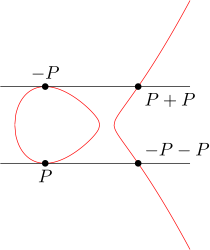
Thus we have a subset
E(Q)⊂E
which is closed under addition.
It is also closed under inverses because
P=(x,y)∈Q×Q
implies
−P=(x,−y)∈Q×Q.
Moreover,
E(Q)
contains the identity element
O.
Therefore:
Proposition 7.3
E(Q)⊂E
is a subgroup.
Definition 7.3 A group G is called finitely generated if there exists a finite set S together with a surjective homomorphism
F(S)→G.
Let us unpack this definition. Suppose
S={s1,…,sn}
is a finite set and
ϕ:F(S)→G
is a surjective homomorphism.
The map ϕ sends each si to some element
gi=ϕ(si).
The fact that ϕ is surjective means that for every
g∈G,
there exists a word such that
ϕ(w)=g.
That is, g can be expressed as a finite product of the
gi
and
gi−1.
In other words, there exists a finite collection
g1,…,gn∈G
such that every element of G can be expressed as a product of the gi and their inverses.
Example 7.2 Every finite group G is finitely generated. Take
and define
F(S)g→G↦g.
Example 7.3 Every cyclic group is finitely generated. If
G=⟨g⟩,
take
and define
F(S)g→G↦g.
Example 7.4 Any finite product of finitely generated groups is finitely generated:
G=G1×⋯×Gn.
Take a generating set Si for each Gi and define
S=S1∪⋯∪Sn.
If
ϕi:F(Si)→Gi
is surjective for every i, define
ϕ:F(S)ai→G↦(1,…,1,ϕi(ai),1,…,1).
One of the most important theorems about elliptic curves is:
Theorem 7.4 (Mordell's Theorem)
E(Q)
is finitely generated.
This result is remarkable: there exist finitely many rational points
P1,…,Pn∈E(Q)
such that every other rational point can be obtained by adding and subtracting these Pi.